
DYNAWALLA
Math is the mechanic
Twenty-five arcade games in which the mathematics is the game rather than a toll you pay to play it. Every one of them meets you where you are and climbs for as long as you do.
The collection concentrates on the ground covered in grades 1 to 5 — addition and subtraction in depth, regrouping and across zero, times tables, long multiplication, division, fractions and the meaning of equality. That is where it concentrates, not where it stops.
All twenty-five games install with the app and play without a network connection.
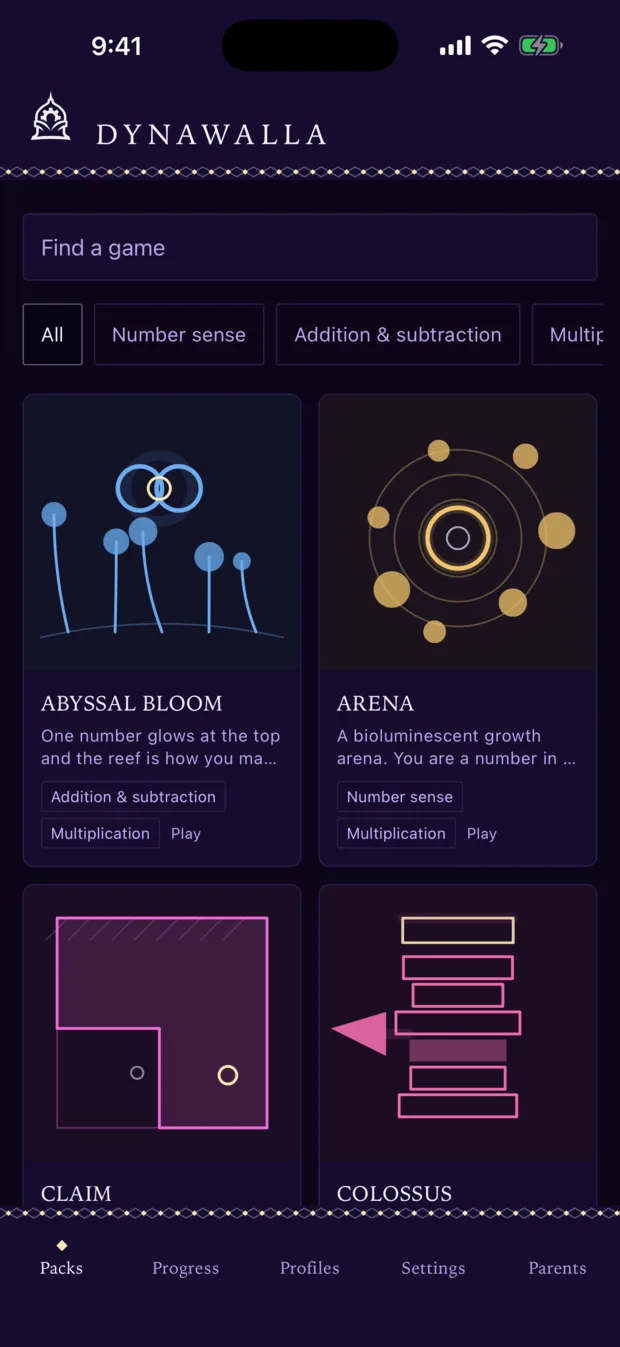
Screenshots
How it works
The maths is the mechanic
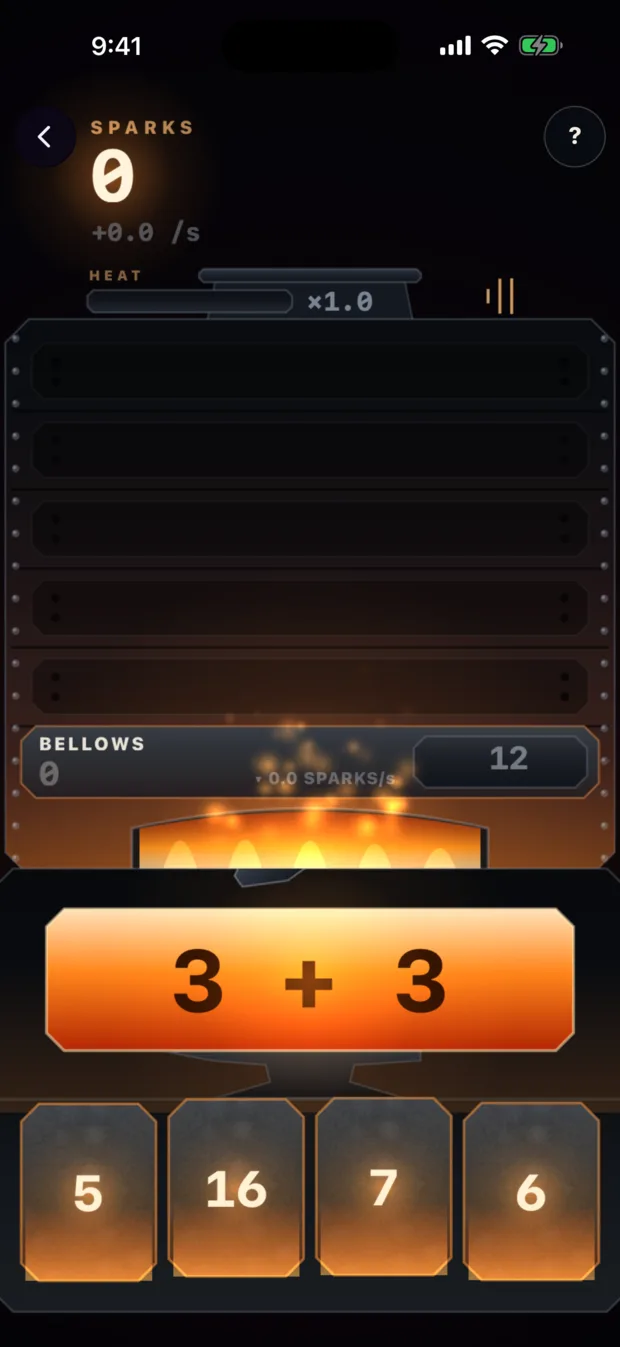
Not a worksheet with a cartoon on it, and not a quiz between rounds. In FORGE, arithmetic is the throttle on a smelting chain. In COUNTERPOISE, a brass balance physically is the equals sign. Doing the arithmetic is how the game is played.
Every player gets their own level
The difficulty follows the player. Someone fluent is given harder work; someone struggling is quietly given easier work until they are succeeding again. It is never announced, and there is no level to pick.
Speed is rewarded, never enforced
Answering quickly earns more. Answering slowly costs nothing — most games put no clock on the thinking at all. A countdown that kills you and a bonus that accrues are the same signal with opposite valence, and only one of them is worth building.
A wrong answer finishes on screen
The sum is completed and held there for as long as you want to look at it. No red cross, no buzzer. Getting it wrong is the moment the game has something to teach, so nothing is hurried past.
Twenty-five games
More arriving.
ABYSSAL BLOOM
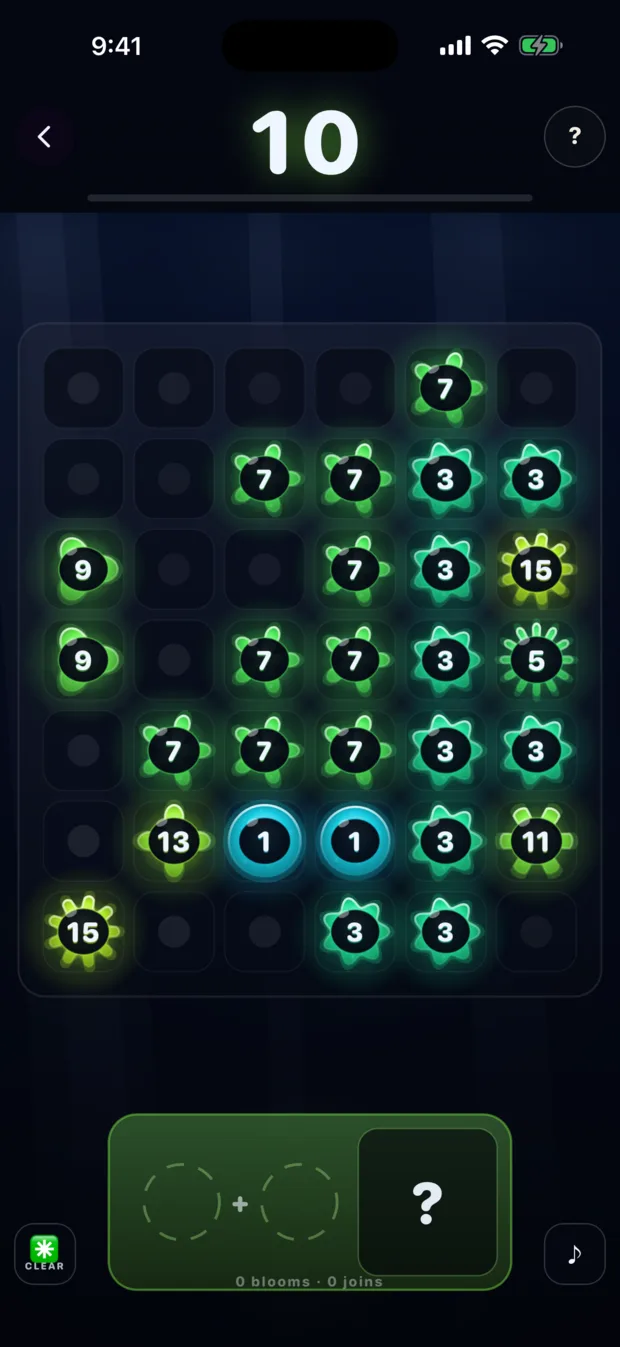
One number glows at the top and the reef is how you make it. Two polyps with the same number join into one worth double; a long press splits one back into halves. Put one to three of them in the mouth to answer it: 23 is 16 and 7. Later the target brings blanks, like 15 = ▢ ÷ ▢.
Addition & subtractionMultiplicationDivisionARENA
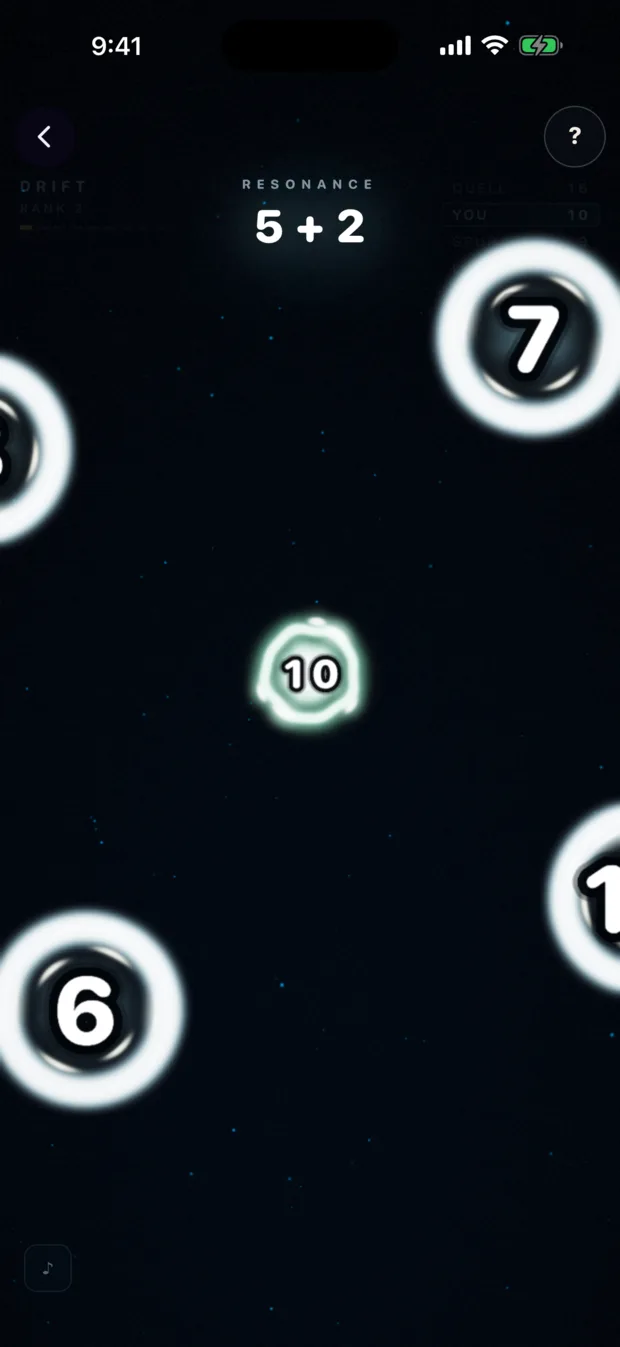
A bioluminescent growth arena. You are a number in a black ocean where everything obeys one radius law, so "smaller than me" is something you see before you read it. Then the water stills, four identical spheres rise, and only the times table tells them apart.
Number senseMultiplicationDivisionCLAIM
Cut the plane and take exactly the fraction you were asked for. Three quarters of the ground stops being something you read and becomes something you carved, with the hunt loose inside the region you have not closed yet.
FractionsCOLOSSUS
You are the giant. A keystone carries a sum; the tower carries numbers. Punch out the floors whose product matches the keystone and the tower comes down on top of you. Strike wrong and the tower gets taller.
Addition & subtractionCOUNTERPOISE
A brass balance where the scale physically is the equals sign. Hang mass until the arm sits level, and the equality stops being a symbol you read and becomes a thing you did with your hands.
Equality & algebraDEEPSWARM
A bioluminescent horde-survivor. Move; the swarm comes; the light wins. Every level-up is a card draw, and the sealed card and the rift both stay shut until the arithmetic written on them is answered.
Addition & subtractionMultiplicationDivisionFORGE
An incremental smelting chain. Every problem struck on the anvil pays sparks, sparks buy stations, and the stations run themselves — the arithmetic is the throttle on a number that only goes up.
Addition & subtractionFUSE
Drop chips into the reactor well. Chips that touch and add to the key number fuse into one.
Addition & subtractionGUILTY
Shoot the Guilty Number. A fixed-position shooter in a bioluminescent trench: the sum descends on four husks, three of them carrying a mistake children actually make, and the bolt has to land on the one that is right.
Addition & subtractionMultiplicationDivisionMATH NINJA
Fruit Ninja with an order to fill. The plate reads 10 + 15 + □ = 33 and the market throws fruit; helpful and decoy gourds look identical, so telling them apart is arithmetic. Nothing is timed, and a dead end is impossible.
Addition & subtractionEquality & algebraMONUMENT
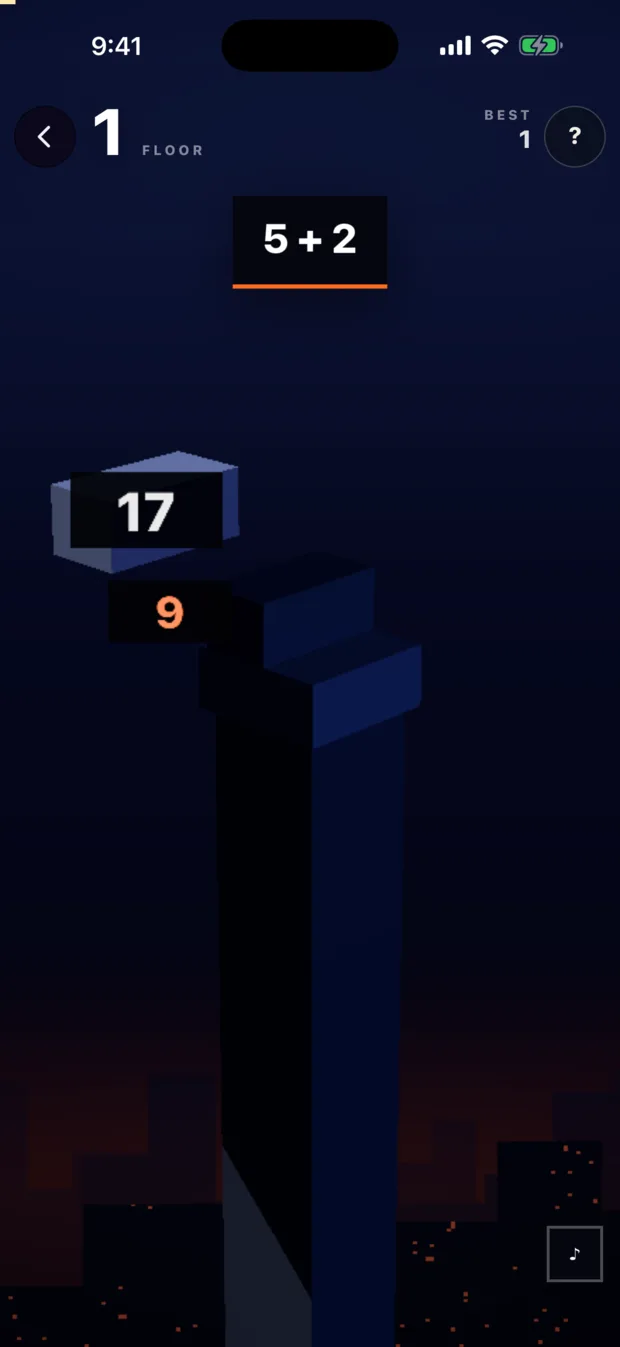
A one-tap precision stacker. A slab sweeps across the tower carrying a candidate answer, and the drop has to be true twice — dead on the edge below it, and dead on the arithmetic.
Addition & subtractionMOSAIC
A stained-glass ball-and-paddle game whose wall is a times table. Eight shattered tiles charge the paddle; press it and four runes rise carrying the answers to one problem — and one power-up each, so knowing the table means seeing which power you are about to get.
Addition & subtractionMultiplicationDivisionPOLARITY
A neon vector shmup where the ship's sign is the arithmetic. A Seal Bearer holds a problem on its hull and drops four orbs; an orb whose sign is not yours is a ghost you fly through, one of your own sign is solid and commits you. Read, pick a polarity, thread the mines.
Addition & subtractionEquality & algebraPULSE
A rhythm-action game where fractions are literally rhythm. The visible playfield is exactly one bar, a note's position is its fraction of the whole, and you answer by hitting a thing at the right time.
FractionsSERPENT
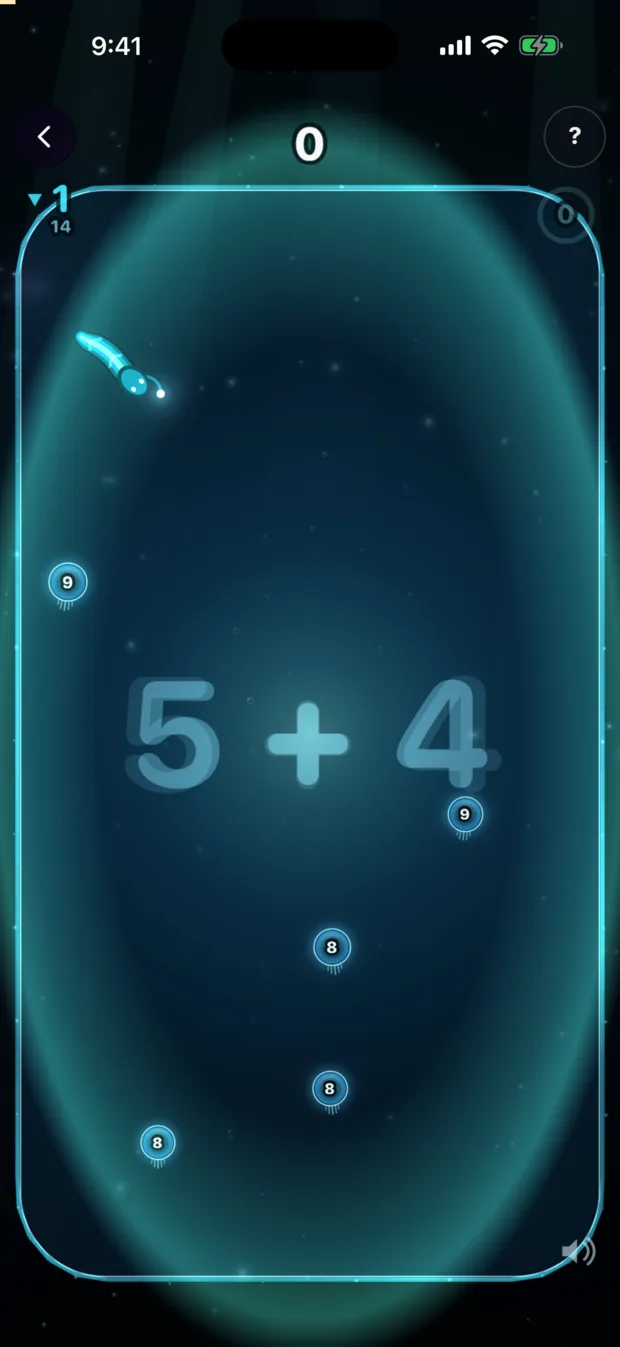
A bioluminescent deep-sea snake that may eat only the values satisfying the condition written across the arena floor. Every orb is a claim, and swallowing the wrong one costs a length of tail.
Addition & subtractionMultiplicationDivisionFractionsEquality & algebraSIEGE
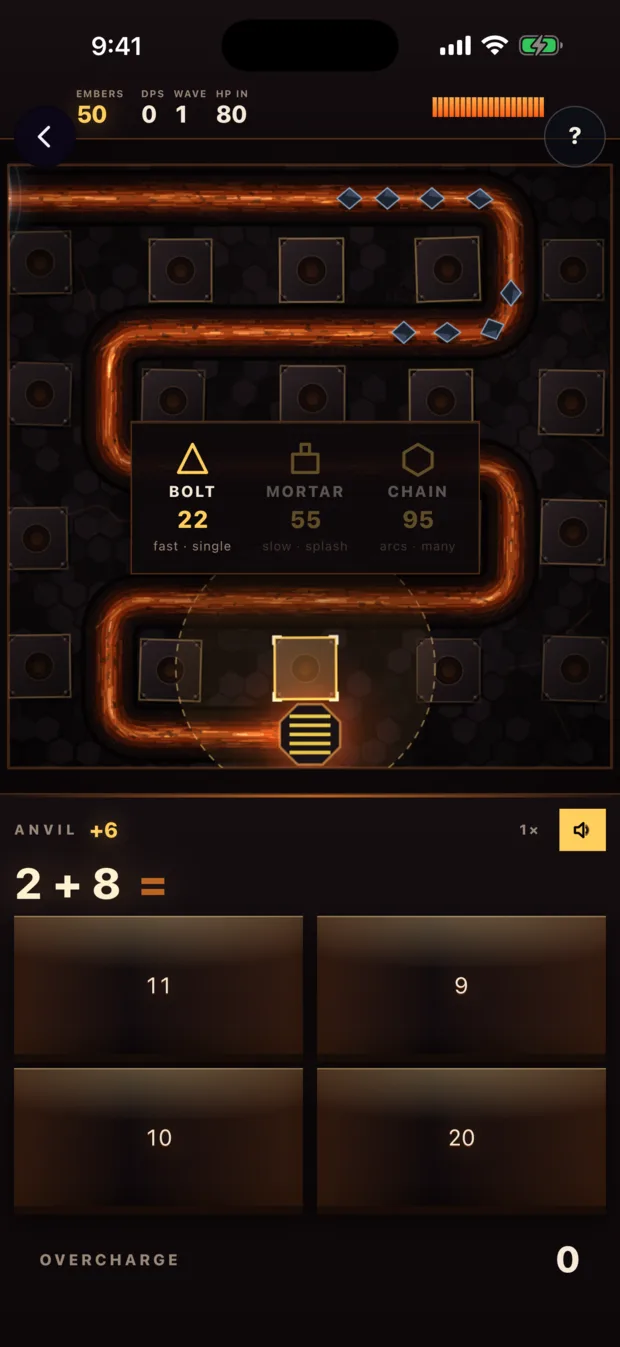
A molten-forge tower defence. The anvil mints embers for every problem you strike, and embers are the only thing that holds the line.
Addition & subtractionSKY LEDGER
The sky is the coordinate plane. Falling stars carry ledger lines; work one out, dial its station on the astrolabe, and it snaps home and blooms. Chain the blooms before the light fades and the observatory writes the whole watch down.
Addition & subtractionSPLITBEAT
A three-lane rhythm game where the bar of music is the fraction bar. The answer is a subdivision you can hear, so a child who can feel the groove can find the fraction.
MultiplicationFractionsTHE COIL OF NINETY-SIX
An articulated brass coil is a number written in place value. Shear off the glowing number — crack a link open when the ones run short — and the machine performs the arithmetic in front of you.
Addition & subtractionTHE LATTICE
A twin-stick arena strung on a mass-spring grid. Shoot a composite husk and it splits along a factor pair; primes cannot be split, so primes are what is left to sweep. Fly into the resonator holding the primes that multiply to what it is asking.
Addition & subtractionTHE STEELYARD
The bazaar's weigh-house. A chit comes over the counter with the lot as a column and no total; hang brass until the beam just tips, then stamp the docket. A level beam is not a reading, so the weight you write is one under the brass. Steel struck in a rhythm shears. No clock.
Addition & subtractionTHE TRUE DRAW
A statement is cut into a slate across the dust. Swipe DOWN to keep it, swipe UP to throw it away. Keep the sums that are right; throw away the ones that are wrong. Right calls fill your bag, a wrong call either way empties it faster, and running out of time costs nothing.
Addition & subtractionTHE TUNING HALL
Five numbered beams of light run down a hall. Ride one and fire, and a pulse destroys an automaton only when the beam divides the number it carries — while the beam sings the remainder against it, and goes pure when it hits zero.
Addition & subtractionTREBUCHET
A siege where the range dial is the answer. Work the sum, wind the arm to that many metres and the keep standing at your number comes down — miss and the boulder lands on the keep your mistake named, out on the field where you can see how far off it was.
Addition & subtractionVOLTA
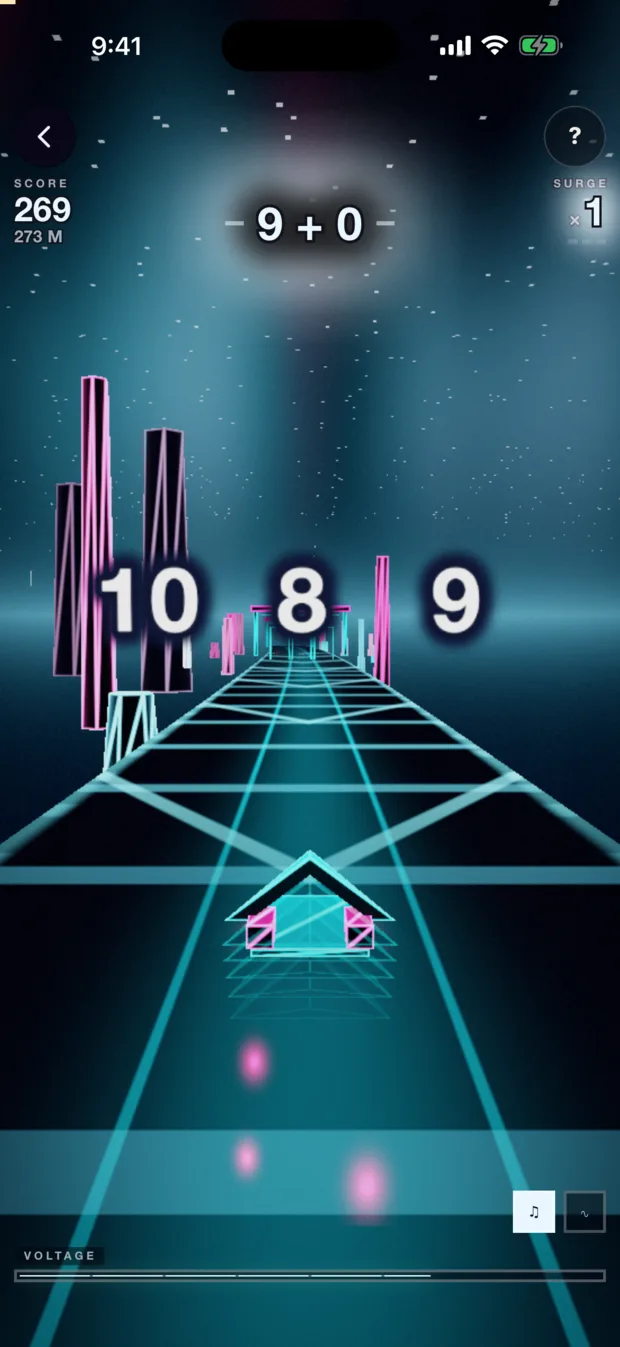
An endless night run along a black glass causeway. Every few seconds a gate array spans the track with a number over each lane and exactly one of them is right — so the lane you are in when you cross is the answer you gave. There is no keypad and no menu: steering is answering.
Addition & subtraction
What is not in it
No advertising. No third-party analytics. No tracking. No account and no sign-in. Nothing to buy inside a game.
Dynawalla is made by Corpora Inc.